I have Support Workers/ paid carers coming here every day to care for me with my disabilities. They need training to try to make sure I’ll be safe in their care. We try to make sure they understand what it’s like for me to receive care, as well as how to practically care for me (what to do to feed me, and use my equipment, and where things are in my apartment, and how I need things done to keep everything accessible for me), and we also teach them a personalised trauma informed approach to help them not traumatise me in the process of carrying out their care of me.
Our training package is constantly evolving and becoming more comprehensive as we’re having more difficulty finding suitable Support Workers with training and experience.
Basic Training Manual
Our first training package is a manual with a pretty photo on each page combined with groups of simple statements about one topic per page, all focused on how support workers can work harmoniously with me and avoid causing basic harm. This manual is still in use, and is especially important for support Workers who have no or a little training. It’s written as gently and as simply as possible. The pretty pictures on the page help make it easier reading as well. It has very simple things in it like telling them what topics to avoid talking with me about, what to expect from me and what not to expect from me, what exacerbates my symptoms, what helps my disability, what I like, what I don’t like, what I like them to do, what I like them not to do, how they can help, how they would make things worse, etc. This training manual was made with my Functional Neurological Disorder (FND) specialist 0T, and with me, and my forensic psychologist looked over it as well and added more ideas to it. A lot of the things in it are based on things we’ve learned from past Support Workers which went wrong, which we don’t want to repeat again. I’ll show you some photos from it in this post.
Video Training Package
Our forensic psychologist Ryan also wrote these questions below with me which will go with a video training package we’ll do for our Support Workers. Each of our main Allied Health team, and one or two central Support Workers and I will do a video which will answer each of these questions as a whole. Then these questions will follow it. The questions will be assessed by my forensic psychologist, Functional Neurological Disorder specialist OT, and specialist coordinator, not by me. We want our Support Workers answering these to be honest and I think they might not answer them as honestly if they know I’m reading their answers.
“A video (or audio) outlining best practice procedures and principles for working with Rach, Rach’s teenager and her home and team.. 1 to 1.5 hours. Then an assessment post viewing of the material.
1. What do you take personally from this training package?
2. What do you believe to be the guiding principles for best practice for working with Rach after watching/hearing the package?
3. Do you believe you have the capacity to work with Rach and if yes.. Why do you believe that, to be so? And if No, please be honest as to why you feel you may not be a good fit?
4. What is your experience in working with complex needs clients? Did you find it enjoyable, exhausting, frustrating, rewarding and disappointing etc
5. What do you predict be a challenge for yourself personally when working with Rach?
6. How do you know when you are at capacity with your work stress, burnout, capability, tolerance, overwhelmed, anger, energy, health etc.. What are your warning signs that you have learnt about yourself working in the helping industry?
7. How do you personally deal with your own life stress and challenges that you feel work for you, and do you have personal and professional supports in your life?
8. Are you open to support or do you feel that you tend to be the one providing others support in your life?
9. What you believe to be the 5 most significant challenges that Rach experienes on a day to day basis? And what’s the impact of them on her?
10 What do you believe to be the 5 most significant challenges for support workers when working with Rach?
11. What would you want to experience if you were needing continuous support workers for every facet of your day to day life including all day to day functions, routines, medications, food, security, cleaning and household chores, cooking, shopping, errands etc
12. How you can make this experience easier for Rach? And why is that important?
13. What are behaviours, attitudes, statements, views, opinions or comments that you could avoid doing that may impact Rach negatively?
14. What are 5 important elements that you have taken from this training package?
15. What are your questions that you would like to ask? Would you like them answered by Rach or her professional team?”
In-depth Symptoms and Trauma Responses Manual
We’re also going to be working on an in-depth manual for support workers about my FND symptoms (like inability to regulate temperature, episodic paralysis and loss of speech, etc), and my trauma responses (like they need to not stand behind me, or make sudden loud noises, or do things which trigger associations with my trauma in the past) with explanations of precedents, the issue which follows, the consequence, what exacerbates it or increases the intensity, and what needs to be learned about it and how it needs to be handled by them, and how I handle it. This will help them have a personalised trauma informed manual to avoid and handle my trauma responses, and also a manual to manage my neurological symptoms. My neurological symptoms are always changing, and my Support Workers frequently change, so this will be worked on regularly by me, and by my Support Workers with my FND specialist OT. My forensic psychologist and I have already spent over 40 hours writing the basis of this document.
Past and Present Training Programs
In the past when disability workers in Australia worked out of agencies before the national public non-hospital National Disability Insurance Scheme (NDIS) was in place, block funding was in place for training, and each disability worker did at least several days of mandatory training each year on things like trauma (in many forms). It was essential. Now the training isn’t essential and it isn’t paid for them to go to workshops or conferences. Each NDIS participant has to come up with their own training program individually with their own Allied Health team for their Support Workers, then they lose their Support Workers and they have to train their new ones.
I’m sharing some of my training ideas here with the permission of the professionals who made them with me, with the hopes these might help others to create their own if you’re needing to create some which are personalised for you or your loved one too.
Basic Training Manual’s First Two Pages
Here are the first two pages in my training manual based around doing no harm for all new Support Workers. This is aimed especially for people with none to little training.

• Follow Rachel’s lead.
• Rachel knows what she can and cannot do.
• Take instructions from Rachel, even if it’s different to how you might do something.
• Please undertake tasks, without offering advice or suggestions.
FND Australia Support Services Inc.
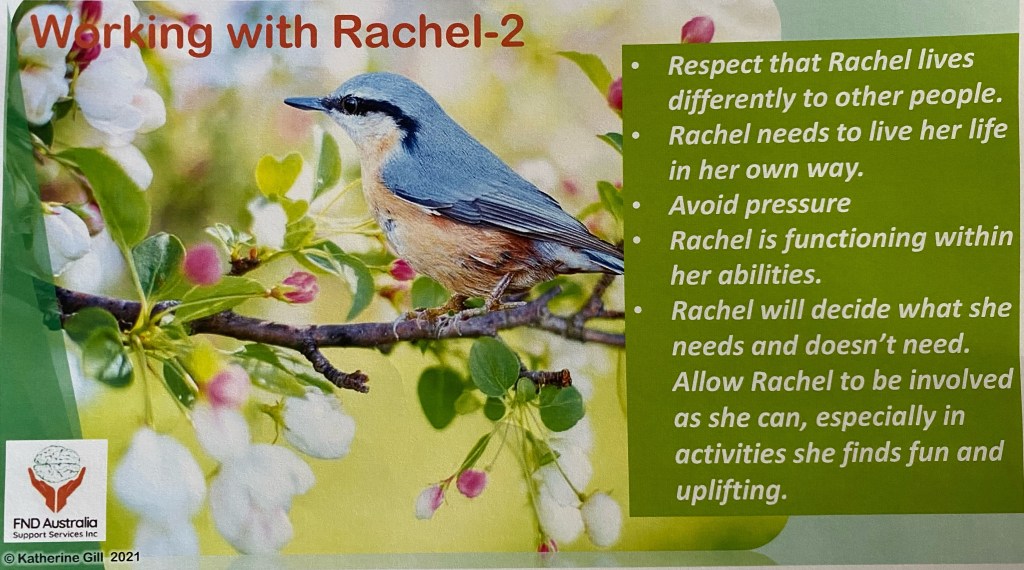
• Respect that Rachel lives differently to other people.
• Rachel needs to live her life her own way.
• Avoid pressure.
• Rachel is functioning within her abilities.
• Rachel will decide what she needs and doesn’t need. Allow Rachel to be involved as she can, especially in activities she finds fun and uplifting.
FND Australia Support Services Inc.
Meet and Greets
In addition, before a Support Worker shows up at our home we meet them by Zoom in a Meet and Greet. This gives us a chance to hear their voice and know if our sensory processing disorder can tolerate the sound of their voice, as we’ll be spending a lot of time with them if they work for us. It also gives us a chance to pick up some obvious things like their attitude to past clients of theirs, their ideas of what Support Work will be like, a sense of if they’re coming ready to be able to work alongside us ready to follow directions or if they’re expecting to run the show and tell us what to do in our own home. We definitely don’t have the energy for that.
Shadow Shift/ Training Shift
If the Support Worker does well in the Zoom Meet and Greet we then have a senior existing Support Worker do a Shadow Shift with them. A Shadow Shift is a training shift which runs for three hours.
At a Shadow Shift we sit down with the new worker and talk for about 40 minutes about a few things Support Workers don’t easily pick up- my extensive trauma history and that I can’t tolerate conversations about violence or animal suffering or suggestions of anything on TV or Netflix involving these, and anything they might not bring up with a torture survivor, don’t bring up with me. And how I’ve been traumatised by religion so talking about religion can also be traumatising for me. To follow my lead in conversation topics, generally. We talk about the importance of my cat to me and how my cat needed caring for in my home, even if that’s different to how cats are cared for in their experience, due to my inability to have my cat upset or meowing repeatedly. Then all the practical tasks are gone through with the trainee Support Worker trying them out after seeing the senior Support Worker showing them how to do the tasks.
There’s a detailed Shadow Shift instruction document we have about each task and where things are kept in case they forget later. It’s nine pages long! Each Support Worker gets this document to take home, and one copy is also always on hand here in a folder along with our basic training manual.
And during the Shadow Shift our senior Support Worker takes the trainee to our pharmacist and our supermarket and shows them where to park and where they buy our things as well, and we here they Post Office is, so they’re familiar with everything.
All the while we’re assessing the trainee for their ability to follow direction, to bond with our cat (if the cat was afraid of the new Support Worker we wouldn’t hire them, as the cat was a very friendly cat and her being afraid of someone meant she picked up something wrong about them before we did- we ignored this in the past and learned the hard way), to socialise on a basic level, and to generally get along with me.
Post Shadow Shift
Once the trainee Support Worker does well in the Shadow Shift and they’re happy to return, we hire them so long as they’ve passed the Police check, Working With Children Check, and have First Aid. If they’re working independently and not in an agency they need to have insurance to keep me safe, and an Australian Business Number to be able to get paid by NDIS and be able to pay tax.
Usually it takes three or four shifts after the Shadow Shift to really know if they’re going to work out or not. It usually takes that many shifts for them to get into the routine of what their tasks are, and to know where everything is, and for us to spot any weirdness which might come out. I’ll do another post at some point about some of the issues we’ve had with Support Workers in the past, and what we’ve learned to keep an eye out for to protect ourselves and our teenager and cat.
Shift Task Checklist
For each shift our Support Workers also have a printed checklist of tasks to either complete, or check if they need completing, or tick if the tasks are done at a level as if they did them that shift. I’ll write more about this in my next post.
Goodbye to our Beloved Sasa
I’ll make a note here that we very sadly had to say goodbye to our beloved cat this week. She was unwell and her medication wasn’t able to manage her pain adequately, and our physical disability wasn’t able to give her her medication any longer either. We’ll love her forever. Our world is upside down getting used to not having her here. I can’t get another cat until the use of at least one hand stabilises more with my neurological disability. So much love to our most Beautiful Sasa, Always. ♥️


 Bed Life and Beyond
Leave a reply to Felicity Wood Cancel reply